
The connected objects of 2026 are no longer limited to watches and smart speakers. The convergence of embedded AI, unified communication protocols, and miniaturized sensors is reshaping product categories. We are witnessing a fragmentation of form factors that pushes manufacturers to rethink the user interface well beyond the touchscreen.
Matter 2.0 Protocol and Interoperability of Connected Devices
The real structural change this year does not come from a gadget, but from a software layer. Matter 2.0 eliminates proprietary silos that have fragmented home automation for a decade. A Thread temperature sensor now communicates natively with a Wi-Fi thermostat from another manufacturer, without a bridge or third-party application.
In practical terms, this means that choosing an ecosystem (Apple Home, Google Home, Samsung SmartThings) no longer locks the user in. Matter-certified devices expose their functionalities via a common data model. The connected home finally becomes modular.
We recommend checking for Matter certification before any home automation purchase in 2026. Many legacy products lack this certification, and firmware updates do not always cover all advertised features. Detailed compatibility analyses are regularly published on geekwise.fr, which helps sort marketing promises from actual capabilities.
Connected Rings and Discreet Biometric Sensors
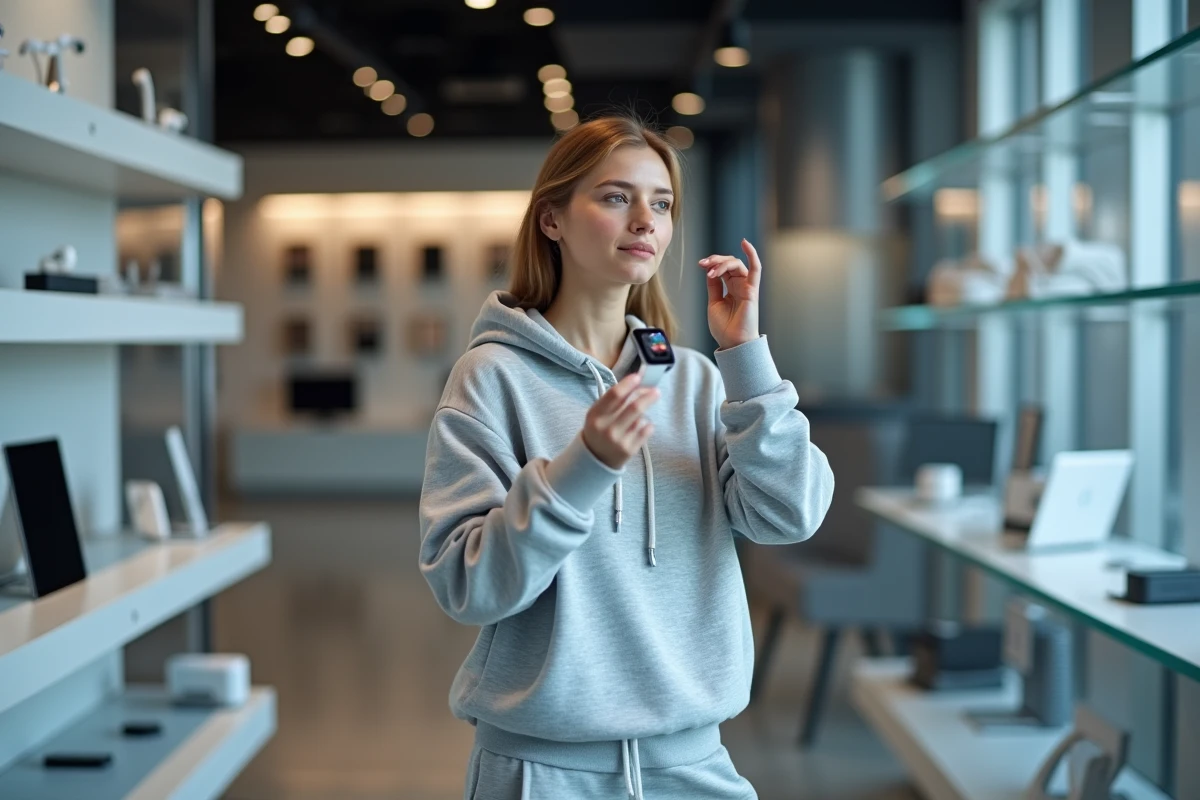
The connected ring is the emerging form factor. The Samsung Galaxy Ring exemplifies this trend: sleep tracking, optical heart rate, and activity detection, all in a few-gram case worn on the finger. The ring replaces the watch for passive health tracking, with no screen to check or strap to recharge daily.
The technical interest lies in the position of the sensor. The finger provides a more stable photoplethysmographic signal than the wrist, with fewer movement-related artifacts. The accuracy of heart rate variability measurement is improved, making these rings relevant for stress tracking via estimated cortisol levels.
Limitations to Know Before Purchase
Miniaturization imposes compromises. Battery life remains superior to that of a classic connected watch, but the battery size limits real-time functions. No built-in GPS, no display: the ring relies entirely on the smartphone for data retrieval.
- Check compatibility with your mobile system (some rings only work with Android or iOS, not both)
- Prefer a model with a skin temperature sensor if sleep cycle tracking is a priority
- Ensure that the companion app exports data in an open format to avoid proprietary data lock-in
Augmented Reality Glasses and Gradual Replacement of the Smartphone Screen
AR glasses replace the screen for navigation and notifications. The Ray-Ban Meta and Nreal Air showcase two distinct approaches: one focuses on photo/video capture and ambient audio, while the other emphasizes projecting a floating virtual screen.
For professional use, heads-up projection changes the game in mobility. Consulting plans, hands-free video conferencing, displaying field data: use cases are multiplying in logistics and industrial maintenance.
Optical Quality and Visual Fatigue
The field of view remains the limiting factor. Consumer models display a still-restricted projection angle, which generates eye strain during prolonged use. We observe that waveguide optical models offer better comfort than semi-reflective mirror solutions, at the cost of higher manufacturing expenses.
The integration of AI into AR glasses opens a second front. Contextual recognition (object identification, real-time translation, summarizing photographed documents) transforms the glasses into a cognitive assistant. This AI-AR convergence will be the differentiating factor for the next generations.

Intimate Connected Objects and the Blind Spot of Data Privacy
An entire category of connected gadgets is absent from general comparisons: intimate connected objects. Remote-controlled sex toys via Bluetooth application, however, represent a rapidly growing branch of IoT, with specific security issues.
Intimate data transmitted via Bluetooth Low Energy is rarely end-to-end encrypted. Several documented vulnerabilities on consumer devices have shown that an attacker within radio range could intercept or even take control of a device. The issue is not trivial: it touches privacy in the strictest sense.
- Require a secure connection (BLE Secure Connections) and pairing code authentication
- Check the data retention policy of the companion app (location, usage frequency, any biometric data)
- Prefer manufacturers that publish a vulnerability disclosure program
This segment illustrates a broader problem: the majority of cheap connected objects sacrifice security for the sake of time-to-market. The lack of firmware updates after commercialization remains the number one risk, regardless of the type of device.
Cloud, Embedded AI, and Technological Sobriety
The trend towards embedded AI (on-device) reduces dependence on the cloud for voice request processing and image recognition. NPU (Neural Processing Unit) chips integrated into the latest SoCs allow for compact language models to be executed directly on the device.
The advantage is twofold: reduced latency and enhanced privacy, as data does not leave the terminal. At the same time, the “Tech Zen” trend is pushing some manufacturers towards electronic ink interfaces and AI-filtered notifications to limit cognitive overload.
This sobriety is not just marketing. E-ink screen devices consume a fraction of the energy of an OLED screen, significantly extending battery life. For gadgets used daily (e-readers, watches, home displays), color electronic ink is becoming a credible alternative to OLED for low refresh rate applications.
The connected objects market in 2026 is structured around three axes: interoperability via Matter, miniaturization of biometric sensors, and local AI processing. The gadgets that will last are those that combine these three pillars without sacrificing data security in the process.