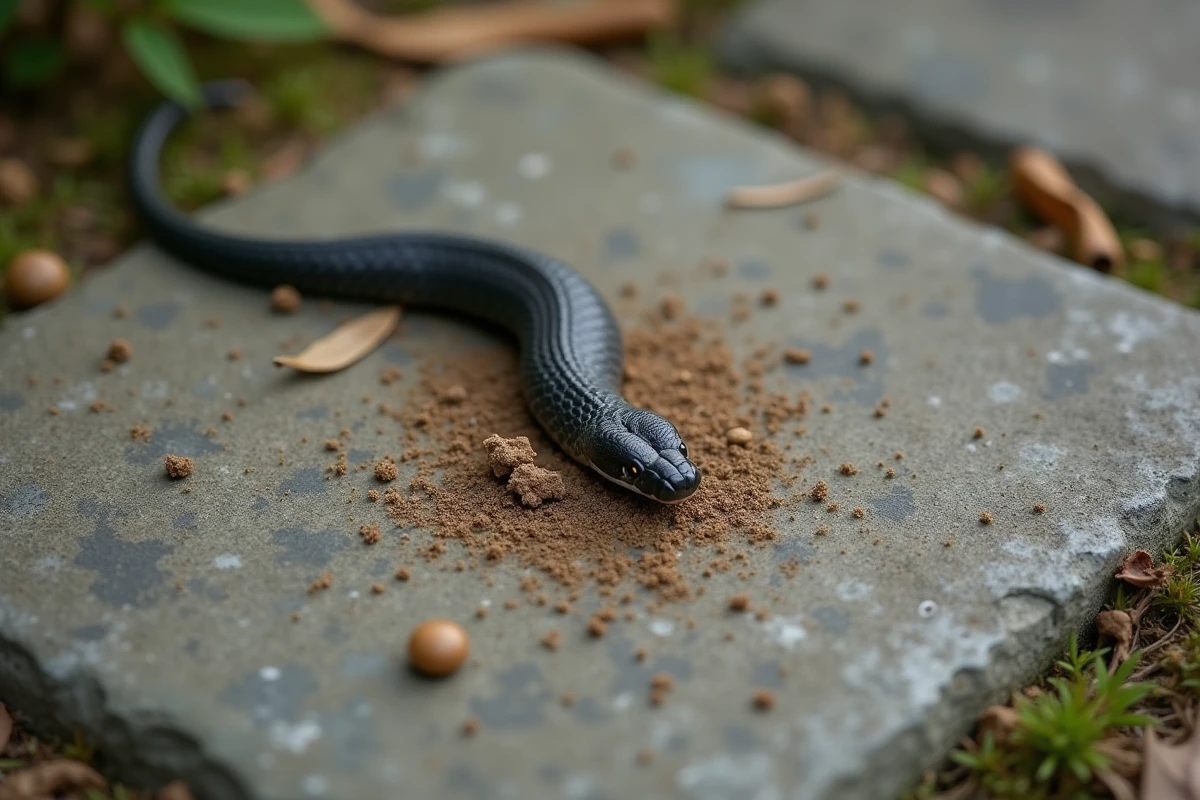
You come across it when turning over a board, moving a pot, or cleaning the edge of a low wall. A small dark, damp pile that looks neither like a cat’s droppings nor a bird’s. Snake droppings often go unnoticed, or worse, are attributed to the wrong animal. Knowing how to recognize them is understanding who truly visits the garden and what ecosystem is developing there.
Snake droppings, hedgehog droppings, or rodent droppings: common confusions
Most identification guides oversimplify. It is often stated that an elongated, dark droppings must belong to a snake. In practice, in the garden, it can be confused with at least three other sources.
Hedgehog droppings are the most common trap. They are also elongated, dark, often left exposed on a terrace or path. The difference lies in the texture: hedgehog droppings contain fragments of insect elytra (mainly beetles), shiny and crunchy when crushed. Snake droppings, on the other hand, may contain hair, feathers, scales, or even small bones, depending on the prey consumed.
Rodent droppings (mice, rats) are smaller, resembling grains of rice, uniformly dark and regular. They are often grouped in clusters along a wall or baseboard. A snake’s droppings are isolated or found in pairs or threes, rarely in a pile.
To identify snake droppings in the garden, focus on a detail that other droppings lack: the white tip, associated with urates. This whitish or chalky part corresponds to the reptilian equivalent of urine, excreted in solid form. Neither hedgehogs nor rodents produce this white appendage.
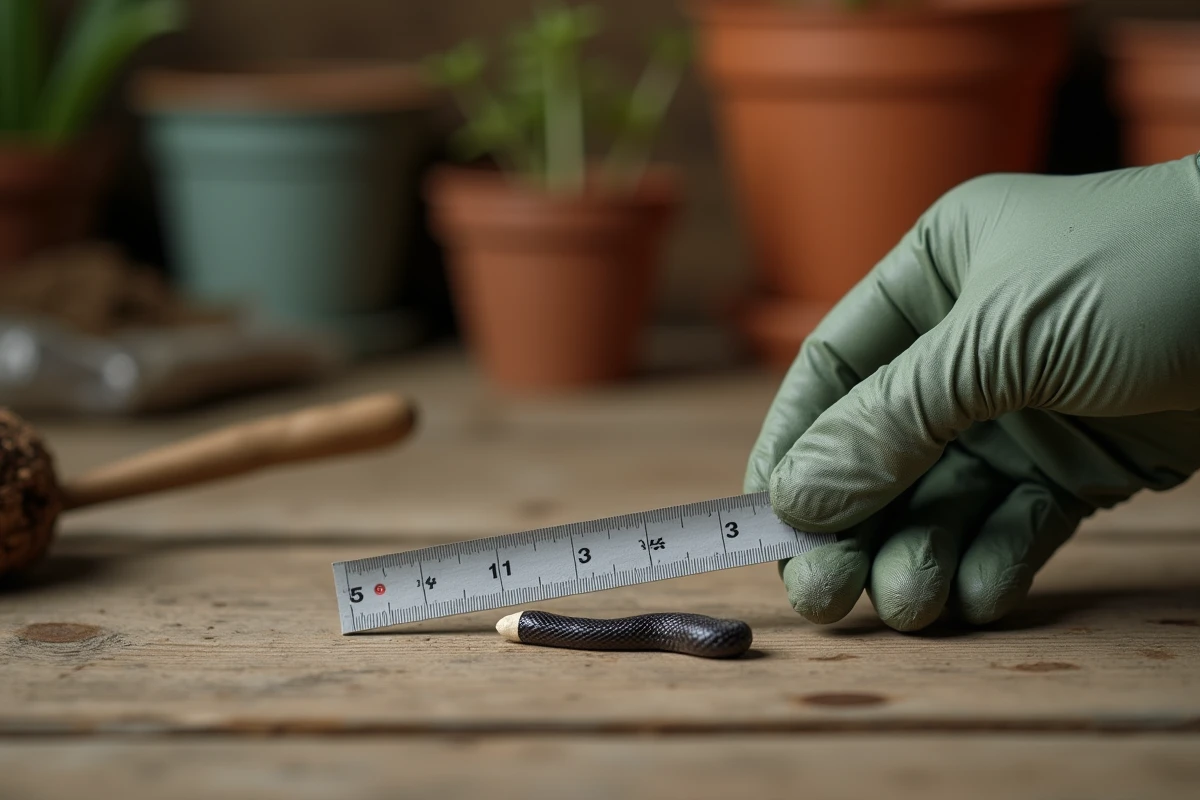
Summary of distinguishing criteria
| Criterion | Snake | Hedgehog | Rodent (mouse/rat) |
|---|---|---|---|
| Shape | Elongated, sometimes twisted | Elongated, cylindrical | Small grain of rice |
| Color | Brown-black with a white tip | Uniform brown-black | Uniform dark brown |
| Visible content | Hair, feathers, scales, small bones | Shiny elytra fragments | Homogeneous plant material |
| Arrangement | Isolated or in pairs/threes | Isolated, often in a thoroughfare | In clusters along a wall |
| Odor | Subtle, musky | Quite strong | Weak unless concentrated |
Snake droppings: what the visible content says about your garden
Snake droppings are not just waste. They summarize the animal’s diet and, by extension, provide clues about the wildlife that circulates in your area.
Fragments of hair indicate the presence of rodents (voles, field mice). If you spot remnants of scales, the snake is likely feeding on lizards. Feathers suggest it catches young songbirds in the nest. In each case, the snake signals a lively garden with an active food chain.
The regular presence of snake droppings in the same spot also reveals a hunting corridor. Snakes often return where prey is accessible. If droppings are found near a woodpile, compost, or stone border, it indicates that these structures serve as a pantry.
However, you should not clean up. Leaving the snake alone protects the garden from rodents much more effectively than a trap or chemical repellent.
Woodpiles, compost, and tall grasses: indirect refuges for snakes
Snakes do not dig burrows. They exploit existing shelters. Understanding what attracts them helps explain why they leave traces in certain specific areas of the garden.
- Poorly ventilated woodpiles provide warmth, humidity, and direct access to rodents that settle there. This is the most common refuge in temperate zones.
- Poorly managed compost (food scraps left exposed, lack of turning) first attracts insects and rodents, then the snake that hunts them. Snakes do not settle in the compost itself but in the immediate vicinity.
- Dry stone borders, cracked walls, and areas of tall grass form movement corridors. The snake moves there under cover, safe from birds of prey.
If droppings are found under a board or behind a storage bin, it is not by chance. The animal uses this shelter as a resting spot after digestion. Reports vary on the frequency of visits, but the same site can be visited several times a week during the warm season.
Collared snake or green snake: adjusting identification according to species
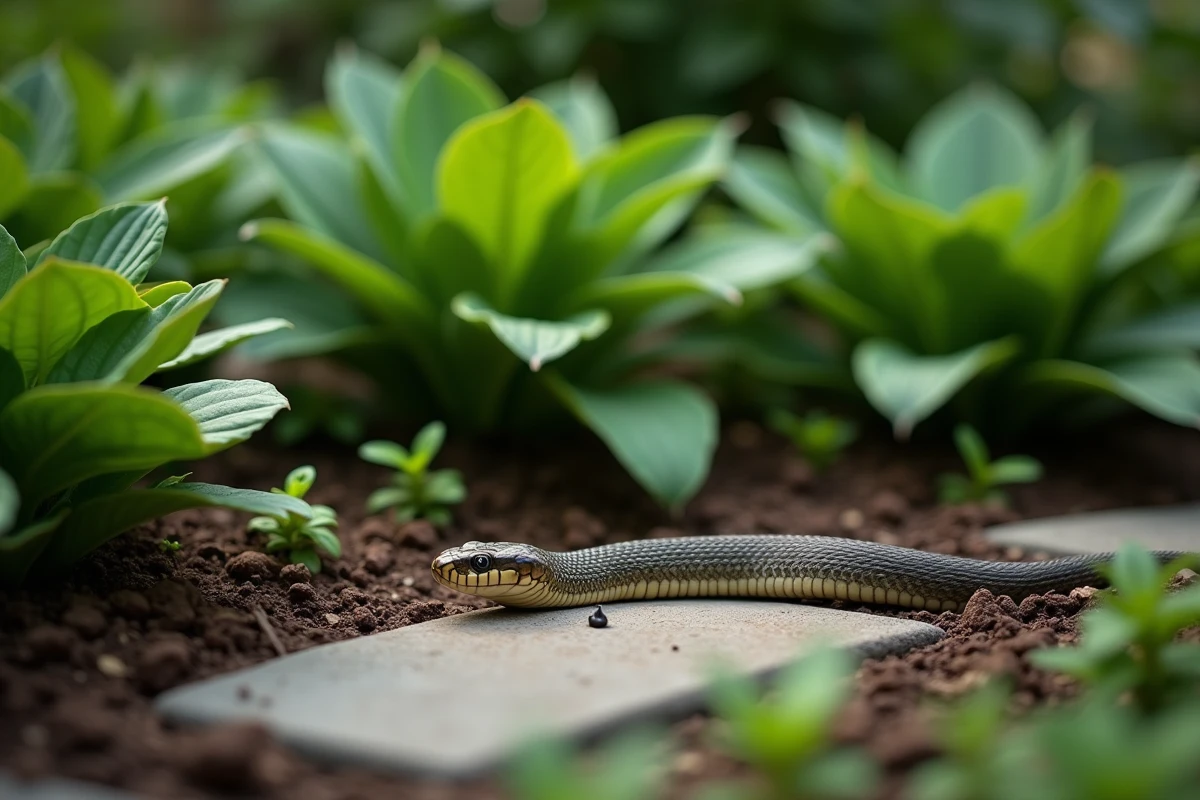
In France, the collared snake is the most common species in gardens. It is recognized by its yellow and black collar behind the head and frequents humid areas (near a water source, pond, ditch). Its droppings often contain remains of amphibians (frogs, newts).
The green and yellow snake, more southern, hunts more lizards and small rodents. The content of the droppings changes according to the species and environment. If amphibian fragments are observed, you are likely facing a collared snake. Remains of lizards point more towards a green and yellow snake.
This distinction is not trivial. It informs about the type of biodiversity present. A garden that hosts a collared snake likely has a functional wet microhabitat. A garden visited by a green and yellow snake offers rather dry and sunny areas with a population of reptiles.
What to do when you find a snake dropping near the house
The most common reaction is concern, especially when the droppings are found on a doorstep, terrace, or in a garage. A few concrete guidelines help maintain perspective.
Snakes are protected species. Capturing, relocating, or killing them is prohibited. A dropping near the house does not indicate an infestation, but a one-time passage, often related to hunting or thermoregulation on a warm surface (slab, asphalt).
If the presence becomes regular and bothersome, act on the habitat rather than the animal. Clearing unnecessary shelters (boards lying on the ground, tarps, debris), mowing borders, and removing indirect food sources (ground bird feeders that attract rodents) is usually enough to reduce visits without harming the biodiversity of the area.
A garden where a snake circulates is a functioning garden. The droppings it leaves behind tell the health of the environment much better than a botanical inventory.